Preface
This is not a book on how to operate a camera. It is concerned, rather, with the invisible sequence of judgments a photographer makes before and after releasing the shutter.
Why Exposure Parameters Are Not Enough
What truly causes hesitation in photography rarely lies among technical parameters. The opening and closing of the aperture, the sweep of the shutter, the scaling of ISO—these are unquestionably the foundations of the craft, but they belong to an order of knowledge that leaves a clear trail: user manuals lay them out with clarity, tutorials explain them in detail, and anyone willing to put in the time can master them thoroughly. What truly holds a photographer rooted to the spot is a different kind of uncertainty, one that surfaces quietly only when confronting the scene. Is this dying, lingering light worth stopping for? Should one wait a few minutes longer in the cooling wind for the scattered figures to coalesce into a collective breath, or frankly accept that the scene will not take shape and simply walk away? For hesitations of this sort, no exposure chart will ever offer an answer.
The further along this path one goes, the clearer it becomes: when we fail to release the shutter, what is missing is seldom technical knowledge, but the resolve to make a decision in the moment. A manual can diagram every dial and lever on the camera body with exhaustive precision, but it can never decide for you where to raise the viewfinder to your eye, nor when to quietly let it rest by your side.
Consider a scene as ordinary as any. At dusk, someone sits by the window of a street-side café, their profile catching the last light of day, a warm drink beside them sending up faint wisps of steam. Anyone passing by would feel a momentary stir. You bring the camera to your eye: the metering is deliberate, focus locks squarely on the eyelashes, the aperture is opened just wide enough to dissolve the cluttered street into soft blur without letting the facial contours slip out of focus, and the shutter speed is comfortably fast. Technically speaking, there is not a single flaw to find. Yet out of the several frames you fire in succession, only one truly holds its ground; the rest, despite having identical settings down to the last digit, invariably feel lacking in some vital, animating breath. That missing quality does not register on any numerical scale, but belongs entirely to the fraction of a second when the subject glances up, lowers their head, or turns toward the passing traffic outside: half a second too early, the expression has not yet coalesced; half a second too late, the steam has already vanished. The camera records all of this with the same unvarnished clarity, but about which exact instant to release the shutter, it will never whisper a single word.
Approached from another angle, the same principle holds true. Under the blazing midday sun, you want to capture a figure standing against the light. The light meter dutifully indicates that bringing the face up to standard middle gray requires an additional stop and a half of exposure. If you follow its advice, the features will indeed become discernible, but the clear, luminous sky and ambient window light behind them will be pushed into a blown-out, chalky white, collapsing the very backbone of the composition. In such moments, the truly confident response is often the exact reverse: add no light to the shadows at all, let the face sink into deep silhouette, and allow only a single rim light to trace the hair and the line of the shoulders. A light meter cannot make this choice for you, for it measures only mechanical "accuracy," whereas you are seeking aesthetic "validity." It is precisely within the unquantifiable, subtle gap between "accuracy" and "validity" that judgment finds its true footing.
This book was originally written for myself of a few years ago, when I was fumbling through my own plateau; today, it is offered to all fellow travelers who find themselves paused on this very same step. Having reached this stage, you handle your gear with total fluency, have exposure parameters committed to instinct, and possess all the lenses and bodies you might need. Yet your photographs often stall in an awkward middle ground: devoid of any obvious flaws, yet incapable of stirring a single ripple in the heart. You know well that you are not incapable of making pictures—your fundamentals are solid. Yet you are just as acutely aware that between this present plateau of competence and the ability to fluently, decisively create images that make your own heart leap, there lies a long, quiet, seemingly unending road. It is precisely this stretch of road that this book is meant to accompany you through.
What a Photograph Changed
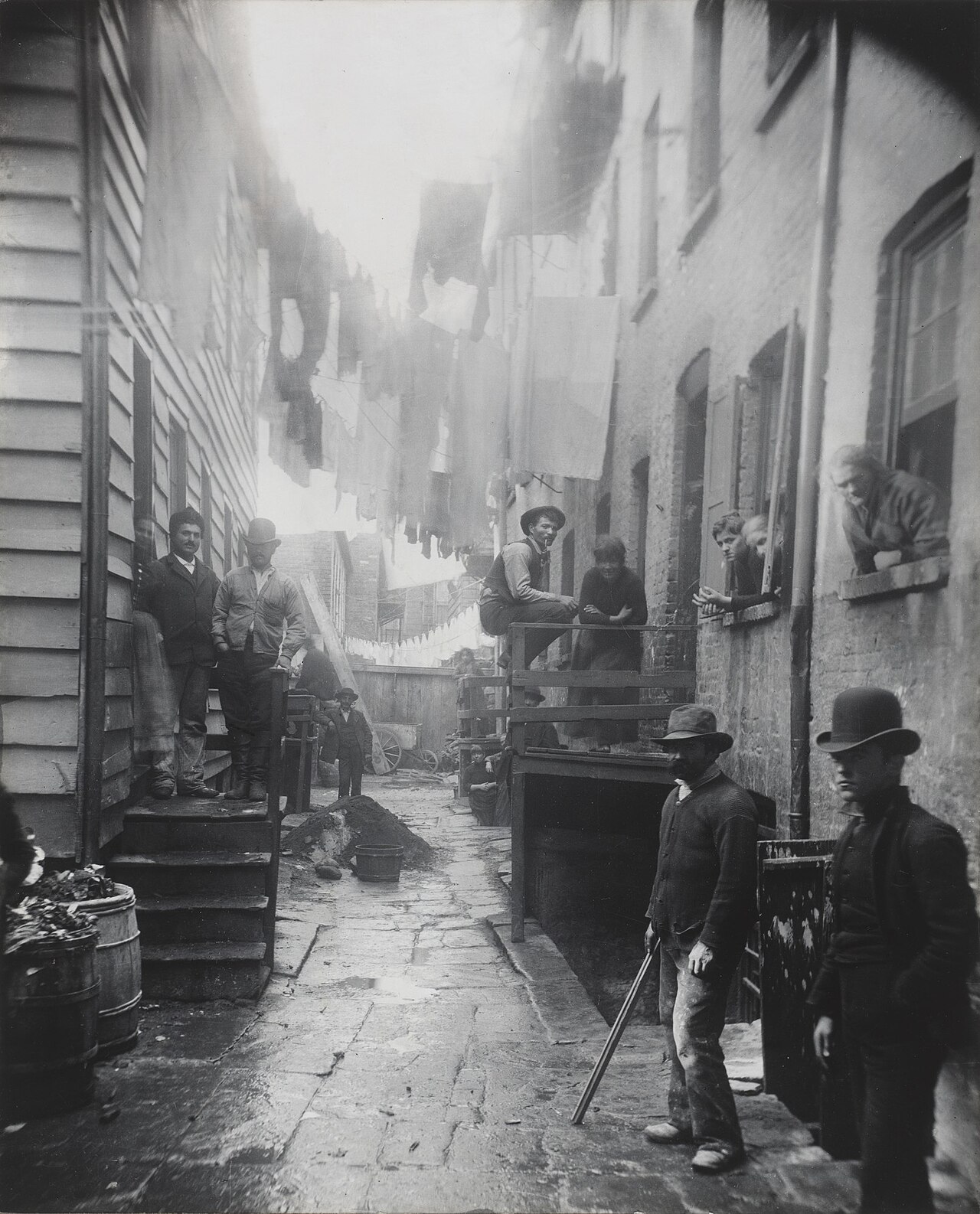
Jacob Riis, "Bandits' Roost, 59½ Mulberry Street," 1888. Riis was a Danish immigrant and a police reporter for the New-York Tribune, stationed across from police headquarters. He and his collaborators used magnesium flash powder—then still a novel technology—to enter the tenements, saloons, and nocturnal spaces of New York’s Lower East Side; this daylight alley scene captures figures in a narrow passageway of Mulberry Bend gazing back at the lens. In 1890, How the Other Half Lives brought together photographs, statistics, and reportage, thrusting slum housing conditions into broader public and policy debate. The subsequent reforms involved multiple forces and cannot be attributed to any single person or book; yet photography here went beyond mere seeing to become an active instrument of public argument. Image Source and Reuse Notes
When Riis made these photographs, his tools were undeniably crude. Ignited magnesium powder erupted in a harsh, uneven flare, frequently scorching nearby faces to chalky white while plunging the shadows into pitch black; measured against modern standards of image quality, the pictures are flawed at nearly every turn. Yet a century later, these images remain searingly compelling. Their power has never rested on the sophistication of the gear, but on another, more hidden kind of measure: he knew which forgotten alleyway to step into; he knew when to direct his lens earnestly toward the human beings before him; and he understood, above all, why he had to release the shutter at that precise moment. These choices, tied to conscience and vision, depend entirely on judgment, not technical settings. Eras pass and instruments evolve without pause, and the industrial shortcomings of the past have long been effortlessly smoothed over by modern technology; but what truly carries a photograph across the years will always be the gaze and the conviction concealed behind the camera.
Are You Stuck on the Intermediate Plateau?
For those stranded on the intermediate plateau of the craft, the underlying frustrations share a striking resemblance. You may not have experienced every one of the subtle states of mind described below, but you have almost certainly crossed paths with at least some of these moments. Take a quiet moment to weigh yourself against them and see which predicament resonates with where you stand today; seeing through your current impasse with utter clarity is often the very first step toward renewal.
First, there is the photograph that is technically unassailable, yet reads no differently than a traveler's casual souvenir snapshot. The exposure is accurate to the fractional stop, the composition conforms dutifully to the golden ratio, and every textbook precept has been scrupulously observed; yet when the images are spread across your screen and you cycle through them one by one, you are forced to admit that they are indistinguishable from the assembly-line scenery of commercial brochures. These pictures are orderly, crisp, and without a single discernible flaw—their sole defect being that, after the initial glance, you can find no reason whatsoever to look at them a second time.
Second, when leafing through the monographs of Magnum photographers, you recognize all too well how masterful those frozen moments are. You gaze at a Mexican street corner through the lens of Alex Webb: rich, searing light paired with cavernous shadows, colors so intense they verge on saturation, and three or four layers of human figures interwoven across planes of sharp focus and blur, composed so densely as to leave scarcely a sliver of superfluous space. You linger over that page in long contemplation, reluctant to turn away; yet once you close the book, take up your own camera, and step back out onto the street, you are left with nothing but an empty sense of bewilderment. What truly sustains that timeless work, and the next time you head out, should you be studying light and shadow, dissecting spatial layering, or cultivating the patience to wait? You can identify a masterpiece when you see one, yet you are still unable to articulate precisely where that arresting power originates.
Third, your knowledge of gear grows increasingly encyclopedic. You can cite the MTF curves, chromatic aberration control, and bokeh characteristics of every lens manufacturer from memory; you can sharply dissect every minute parameter in the EXIF data of any photograph. Yet when you actually stand at a street corner and witness a frame charged with tension quietly coalescing before you, these cold metrics cannot make up your mind for you—they cannot tell you which lens to mount at that split second, nor can they take those two crucial steps closer to the scene on your behalf. They can meticulously explain after the fact how an image was recorded, but they cannot grant you the courage and intuition needed to capture it in the moment.
Fourth, you gradually find yourself trusting your ability to make a good photograph only under the most demanding circumstances. You insist on waiting for an unexpected morning fog, an exotic and unfamiliar alleyway, or that single half-hour of low-raking sunlight before feeling certain that the world before you warrants a release of the shutter. Once returned to the mundane rhythms of daily life—with the same concrete pavement you have walked a thousand times beneath your feet and the harsh, bleached glare of midday sun overhead—the camera suddenly feels too heavy to raise. Without realizing it, you have staked the creation of strong photographs on fortuitous windfalls; whether or not you press the shutter is no longer governed by your own way of seeing, but seems entirely dependent on the charity of weather and geography.
Fifth, you are profoundly struck by a surge of emotion on location, yet upon opening the files at home, you can no longer retrieve that momentary flutter of the heart. Standing in that space, the slight chill of a passing breeze against your skin, the tender warmth of twilight grazing the eaves, and the ambient hum of the street all interwove with the swelling thoughts in your chest—and you pressed the shutter almost purely on the impulse of that raw fervor. Yet the lens does not absorb these fluid, living experiences of its own accord; what it preserves, in the end, is nothing more than cold light and physical form. Thus, what you actually recorded was only your unanchored internal emotion at that moment, rather than a visual structure capable of carrying and transmitting that emotion to others. What stands between the two is, as ever, judicious discernment: at the very peak of emotional resonance, can you step back half a pace, detach yourself with composure, perceive clearly which core imagery is moving your soul, and determine what pure geometry and tonal distribution can anchor it firmly within the frame?
And so, after roaming outside all day and firing the shutter hundreds of times, you spend hours culling the take at home, only to find that the frames you can share with genuine confidence amount to no more than a meager handful; the vast majority sink into the depths of your hard drive, likely never to see the light of day again. Along the way, you may have switched systems with frequency, migrating between brands and sensor formats, imagining with every touch of a pristine camera body that a breakthrough was imminent; yet after a few months have passed and the novelty has worn off, you find yourself lingering at square one: your operation of the machine has grown increasingly deft, but your photographs have not taken a single meaningful step forward.
These frustrations, though seemingly matters of technique, are all rooted in a loss of judgment. You already possess the ability to render a scene sharp and clear, but you have not yet grasped which elements deserve meticulous articulation, which should be cast decisively into deep shadow, dissolved into bokeh, cropped outside the frame, or left unrecorded altogether. This subtle sense of proportion and restraint can never be acquired from an instruction manual alone. You may be able to transcribe the Zone System from memory without a single error, fully aware that it spans from the featureless pure black of Zone 0 to the pure white of Zone 10, with each zone representing exactly one stop of exposure and Zone 5 serving as the baseline 18% neutral gray; yet the next time you stand by the sea facing a sunset, you may still casually spin the dials purely on gut feeling, only to discover at your computer that you overexposed or underexposed the frame by a full stop. Committing principles to memory is one thing; whether they can translate into instinct in the unpredictable crucible of a live scene is entirely another.
Such discrepancies are everywhere. You have read the rules of spot metering for backlit portraits a thousand times, knowing precisely how to lock exposure before calmly recomposing; yet in an actual setting, when the light is sublime and the smile is radiant, your entire focus is consumed by that fleeting expression, leaving no room to attend to cumbersome metering procedures. You know full well that the reciprocal rule dictates a safe shutter speed roughly equal to the inverse of the focal length, and you understand that camera shake destroys fine detail; yet when a breathtaking moment unfolds abruptly before you, the finger often fires first, and only when enlarging the file at home do you discover motion blur across the frame. This does not stem from a deficiency in knowledge; on the contrary, you understand the theory just as well as anyone else. The true crux of the problem lies here: textbook knowledge is neatly categorized and tidily arranged, whereas the reality on the ground rushes at you like a torrent—light shifts rapidly, people move through the frame, and time whispers its urgency at your back, leaving no room for a leisurely search through memory. Whether you can summon the most precise instincts with poise in that split second depends not on rote memorization, but on a physical muscle memory forged through thousands of acts of looking and choosing.
The original intention of this book is precisely to bring these subtle judgments, hidden before and after the release of the shutter, out into the open light and dissect them with deliberate care. They are called hidden because these choices are often settled in the fleeting flash of raising the camera to the eye—occurring so fast that even the photographer struggles to untangle the thread of their own reasoning. This book cannot lightly promise the illusion of mastery upon closing its cover—such a pledge is always frivolous in the realm of art—but it can at least illuminate the road ahead, clarifying where your future efforts ought to be directed so that you do not squander your time wandering down blind alleys.
To bridge the chasm between intellectual understanding and instinctive execution, this book chooses a path that may appear unhurried and deliberate, yet is profoundly steadfast. Whenever a critical judgment is discussed, it refuses to settle for tossing out a ready-made formula; instead, it strives to meticulously dismantle the underlying logic of observation: what exactly is being scrutinized here, why these specific inclusions and exclusions were made, what visual clutter arises from a misreading, and what serene order reveals itself once the scene is truly understood. Going into such exhaustive detail is intended so that, the next time you find yourself in a similar situation, what surfaces in your mind is no longer a dry, rigid dogma, but a vivid visual schema you have thoroughly reasoned through and internalized. Dogma is all too easily scattered by the wind, but an insight that has been thoroughly understood will return naturally at the decisive moment, guiding your fingers and your gaze.
Who This Book Is Not For
Before diving in, it is necessary to define the boundaries of this book, lest you invest your valuable time only to find that it does not serve your needs.
If you cannot yet effortlessly distinguish the physical implications of aperture, shutter speed, and ISO, this book will likely prove to be hard going, as it assumes from the outset that you have already crossed the threshold of basic mechanical operation. If you are at this stage, it would be better to first find a solid introductory text, or simply switch your camera to full manual mode, point it at a single still life, and repeatedly turn those three dials, observing with your own eyes every shift in exposure, depth of field, and motion blur. Spend two focused weekends doing this until these mechanical interactions become second-nature finger movements; only then, upon returning here, will you be able to appreciate the poise of the discussion.
At the other end of the spectrum, if you have already mounted several established solo exhibitions, published your own monographs, or already make your mark through a deeply mature photographic visual language, then this book may well be too elementary for you. The judgments unraveled throughout these pages have undoubtedly become as natural to you as the breath in your veins, requiring no external annotations.
The true companions of this book are the vast majority situated between these two extremes: those who have mastered their gear and know their camera settings inside out, yet when confronting the frames they have captured, often find themselves trapped in an impasse—unable to articulate what works, unable to diagnose what falls short, and unsure of how to break through the plateau. This book is written precisely for such seekers.
Letting Go of a Few Fixations
Before setting out, it is worth gently laying aside a few common fixations. In themselves they are hardly grave transgressions; yet when allowed to govern one's attention, the path of photography tends to meander down many unnecessary detours.
First is the obsession with gear. Cycling through different camera systems multiple times in a single year is less a creative exploration than a consumerist reflex designed to soothe anxiety. With every switch of body, you spend weeks relearning button layouts, menu hierarchies, color rendering, and the balance of the grip; the tactile joy of handling a new object is real enough, and a new camera can indeed ignite a short-lived urge to get out and shoot, but ultimately it cannot fundamentally deepen the way you observe the world. More often than not, what truly demands your scrutiny is not sensor size or lens coating, but a far more searching question within: Why do you hesitate before certain subjects, and why do you find yourself perpetually agonizing, unable to make a definitive judgment, before particular kinds of images?
Second is the fascination with absolute sharpness. Pushing sharpness, micro-contrast, and resolving power to their limits does not endow a photograph with a soul. An image that is impoverished in light, timing, and substance remains hollow, even if every individual strand of hair is rendered with pin-sharp fidelity. Sharpness merely signifies the completion of a basic optical record; the span between a simple optical recording and a compelling work that withstands sustained contemplation is a vast mental distance. The inner workings that unfold across that long distance are precisely the landscape this book strives to open before you.
Post-processing is another path along which one can easily lose one's way. High dynamic range blending, lurid color saturation, and one-click preset filters are all neutral tools of the modern digital darkroom; applied judiciously, each has its distinct virtue. Yet if a viewer's first instinct upon seeing a photograph is to identify which trendy style was applied, the heavy hand of manipulation has upstaged the subject, and whatever vitality the photograph originally possessed is driven into retreat.
As for the widely celebrated "decisive moment," Cartier-Bresson's contribution remains an indelible beacon. He truly articulated one of the most breathtaking realms in street photography: that fleeting instant when the eye, the mind, and the heart align on a single focus, and geometric composition locks seamlessly with emotional metaphor. Yet in the years since, photography has traversed nearly a century of rich and varied history. The world is vast, and the realm of things worthy of contemplation is immense; photography is by no means confined to a single second of geometric coincidence on a street. We may revere the masters and draw sustenance from them, but there is no need to elevate their doctrine into the sole yardstick against which every diverse exploration must be measured.
As for the frequent refrain that "photography is self-expression," there is truth in the sentiment: as one's practice deepens, the photographer's temperament and disposition will inevitably settle into the tonal fabric of the work. But to hang this motto above one's desk too early in the journey risks reducing it to hollow self-indulgence. Photography is, first and foremost, a deeply concrete and grounded craft: it is quiet observation, precise decision-making, the ordering of fleeting reality, and an honest, steadfast dialogue established between an individual wielding an optical instrument and the world standing before them.
What This Book Passes Over Lightly
Certain technical details that are rehearsed ad nauseam elsewhere will receive only a light touch in this book. The tedious configurations of nested camera menus properly belong within the user manual; laboratory optical benchmarks across various focal lengths are handled far more rigorously by dedicated testing institutions; and as for the rudimentary mechanics of sliders in editing software, online tutorials already exist in overwhelming abundance. This book will certainly delve into the digital darkroom, but its focus will always remain on the exercise of intent: when a RAW file opens before you, which subtle glimmers of light deserve nurturing, which distractions must be decisively suppressed, and at what threshold of processing one must know when to stop.
This book carries its own aesthetic inclinations and narrative voice; in its deeper explorations, the author's personal stubbornness and preferences will inevitably show through. When you come upon those passages, there is no need to nod along in hasty agreement. A far more rewarding state is when it awakens an authentic inner resonance: one section resonates deeply, another stirs disagreement, and yet another demands testing in the field. All of these reactions are wonderful forms of dialogue. If a book on photography can prompt you to pause a moment longer before your own work and gaze a few moments more at the breathing depth of the shadows, it has fulfilled its purpose.
A Map of the Book
Before embarking on a close reading, it is worthwhile to unfold the texture of the entire book like a scroll. Progressing from foundational principles to advanced inquiry, the book is divided into four organically interconnected parts. With this panoramic map in mind, you will clearly understand where each chapter sits within the broader architecture of photographic understanding, and what purpose it is meant to serve.
Part I comprises four foundational chapters: Seeing, Light, Exposure, and Color. Together, they explore two essential questions: what, precisely, have you discerned within a cluttered world, and how do you use an optical medium to translate that discernment into poetic order on a two-dimensional plane? Seeing concerns an unadorned aesthetic distillation—the keen ability to capture that truly stirring glimmer of light amid boundless clutter. Light aims to reshape our perceptual sensitivity to illumination, discerning the subtle shifts in its direction, quality, and color temperature. Exposure is dedicated to translating the dynamic play of light and shadow before you into a tonal scale that the sensor can comfortably hold and that faithfully reflects your intent. Color investigates the tension and harmony born from juxtaposing different hues, and how these visual relationships quietly steer the viewer's emotions. These four chapters form the cornerstone of the entire book; whatever genre you may venture into hereafter, your footing begins here.
Part II explores the interplay between tools and space: The Language of Lenses and Timing. The discussion of tools here is by no means an exercise in comparing which lens yields higher resolving power; rather, it aims to clarify how different physical focal lengths and camera positions fundamentally reshape both the spatial relationship and the psychological distance between you and your subject—why a wide-angle lens compels you to step boldly into the scene, and why a telephoto lens compresses mountains and earth into a single instant. As for timing, it attends to the meditative patience of waiting and the foresight of anticipation: stirring moments are rarely stumbled upon aimlessly; rather, you perceive the first seeds of order ahead of time, take your position with composure, and wait quietly for the scene to step into the frame.
Part III presents a sixfold gaze across distinct genres: Portraiture, Street, Landscape, Architecture and the City, Low Light and Night, and Black and White. The internal discipline cultivated in the first two parts is now applied fully to vivid, concrete photographic scenarios: directing spirit and engaging gazes in portraiture; swift reflexes and social observation on the street; geological time and solitary vigil in landscape; rigorous geometry and perspective correction across architectural facades; honoring the dignity of shadows in the dark of night; and the purity of form once color is stripped away in the black-and-white realm. Though each genre takes a different shape, what is mobilized beneath them is the very same unified set of aesthetic judgments.
Part IV turns to the ultimate realization of the work: Post-Processing and Editing, Series, and Long-Term Projects. Pressing the shutter brings the creative act only halfway to completion; what follows is the final sculpting of tone and form, along with the cold, objective curation required to sift through a vast sea of frames and identify the few that truly stand on their own. This section is placed as the finale because no amount of darkroom labor can rescue a fundamentally weak photograph at its core, just as no elaborate sequencing can breathe a soul into a scattered collection of unexamined images.
How to Use This Book
The path of reading varies with the individual. I recommend working through the first four chapters sequentially: Seeing, Light, Exposure, and Color form the common foundation that underpins all specific genres. Of course, should immediate practical needs compel you to jump directly to a particular chapter for guidance, you are certainly free to do so; yet without the aesthetic logic established in those opening chapters, it is all too easy to slip back into mechanically applying templates—understanding neither why a convention works, nor when it ought to be decisively broken.
As for the genre chapters, feel free to start with the ones you are most drawn to, though I strongly encourage you to read through the unfamiliar ones as well. The perseverance forged in landscape, the acuity sparked by the street, the empathy honed in portraiture, and the sense of order demanded by architecture—these faculties quietly nourish one another, serving as inner core and outer expression. When someone accustomed to photographing architecture steps onto the street, the lines and planes in their frames often display an uncommon crispness; and when someone skilled in portraiture walks into nature, they bring a distinct sensitivity to the breathing space of the foreground and the scale of the human figure between heaven and earth.
Placing post-processing and editing at the close of the volume follows the natural law of creative work itself: first comes the precise capture in the field, followed by restrained completion in the darkroom; first comes the quiet polishing of frame by frame, making possible the expansive narrative of a cohesive body of work.
Stances Maintained Throughout This Book
Finally, there are several resolute stances that will echo repeatedly through the chapters ahead; it is worth setting them down clearly here at the outset:
First, insist on shooting in RAW, unless you are using Fujifilm film simulations and have an entirely lucid reason for relying on straight-out-of-camera JPEGs. The true gift of RAW lies in permitting us to defer a portion of our delicate decisions regarding tonality until we return home, where they can be weighed at leisure. Out in the field, we are often buffeted by gusting winds, shifting light, and chaotic distractions, with time pressing silently at our heels; but seated at our desk before a screen, the mind is tranquil and lucid, far better able to discern the true destination toward which an image yearns. What RAW buys us is the spacious grace to revisit the scene and examine it anew with composure.
Second, using Auto ISO judiciously is by no means an act of laziness. The mental arithmetic and fussy calculations it spares you in the field can be converted in full into precious attentiveness—devoted to the breathing rhythm of your composition, the seizing of timing, and the fleeting micro-expressions of human subjects, which are the truly irreplaceable soul of capturing a scene. Setting aside two extreme scenarios—one being a still-life studio under fully controlled lighting where the pursuit is an impeccably clean base ISO, and the other being long exposures at slow shutter speeds that demand precise calculations of light trails—in the vast majority of everyday creative work, you can trust it completely, provided you set a sensible ceiling for noise.
Third, prioritize the viewfinder, reserving the LCD screen for extreme high and low camera angles. The moment you press your eye to the viewfinder, distractions from every quarter are shut out completely, and reality is condensed by the unyielding frame into a self-contained universe, forcing an immediate verdict: within this square inch of space, what is to be admitted, and what is to be resolutely cast out? If you spend years framing solely through a floating screen held at arm's length, the decisive resolve required to make these threshold judgments can rarely be truly forged.
Fourth, flash is an incisive blade for sculpting light and shadow, not a blemish that ruins natural atmosphere. The apprehension many feel toward artificial light stems not from any inherent defect in the tool, but from not yet knowing how to wield it with soft, discreet restraint. In its essence, light knows no distinction between natural and artificial; what matters is whether you understand how to let it breathe organically within the scene.
Fifth, mobile devices are equally valid instruments for serious photography. Every principle explored in this book—from the sculpting of light, geometric order, and the anticipation of timing, to the tension of color and darkroom restraint—remains entirely valid on a smartphone. The physical constraints of smaller sensors, fixed focal lengths, and narrower dynamic range do not diminish the essential charm of photography in the slightest. If, equipped with nothing more than the phone in your pocket, you faithfully carry out the observational exercises across the first six chapters, the transformation you undergo will often far exceed what could be bought with a set of expensive gear.
Letting Knowledge Enter the Body
At the close of each chapter, you will find carefully crafted practical exercises. When you close the book, your mind may well be clear, yet your fingertips and gaze have not necessarily absorbed this understanding until it becomes as natural as breathing. To refine an aesthetic judgment from "I know this" into effortless instinct, the only sure path is to step repeatedly into the field, return home to cull your frames, and hone your sensibilities through daily observation. For this reason, every exercise has been kept to a manageable scope that can be completed in a single outing, and each one without exception requires you to conduct an honest edit once you return home.
The discipline of culling carries immense weight. Releasing the shutter is an outward intake, whereas selecting among your exposures is an inward examination; if someone spends years greedily pressing the shutter without ever sitting down in quiet to confront their own work, their eye is bound to remain stagnant. Only when frames that look deceptively alike yet fundamentally diverge are laid out before your eyes, in the unsparing crucible of comparison and elimination, will you be forced to see clearly: what it is that you truly value, and what was merely a superficial illusion. Chapter 14 will explore the art of culling and editing in full detail.
Setting Out from Here
The aspiration of this book is, in truth, exceedingly modest: may it accompany you through a long journey of making photographs, allowing you to gaze a little longer and more quietly at your own work; and when years have drifted past like water, may you clearly recognize, from among a vast sea of prints and negatives, the unmistakable gaze of your own eyes.
What we call style and vision are never off-the-shelf labels hung at the starting line for anyone to pluck; they are the contours of a life gradually revealed beneath the washing tide of time, forged across tens of thousands of instances of gazing, recording, and resolutely letting go. As for how far one can travel down this path, it depends entirely on how many sincere years you are willing to surrender to it, and how much unvarnished truth you dare to lay bare before your own work.
Next Chapter: Chapter 1 Seeing